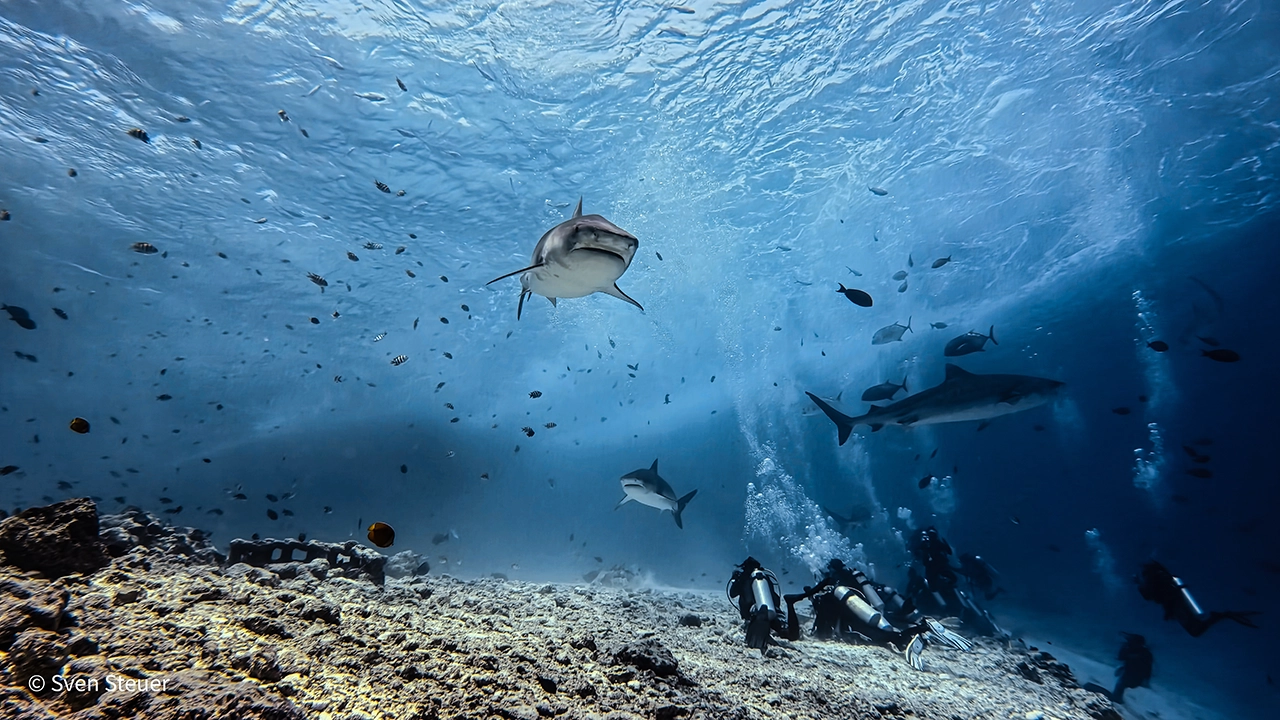
Tiger sharks and divers
Encounters with tiger sharks are among the most impressive experiences in the sea. At the same time, they show how important experience, calm and respect are around large sharks.
Diver on Tour Knowledge
Behaviour, rare incidents and what we can learn from them.
Encounters with tiger sharks are among the most impressive experiences in the sea. At the same time, they show how important experience, calm and respect are around large sharks.

Tiger sharks are among the most successful predatory sharks in the world. Their broad diet and adaptability make them fascinating marine animals.
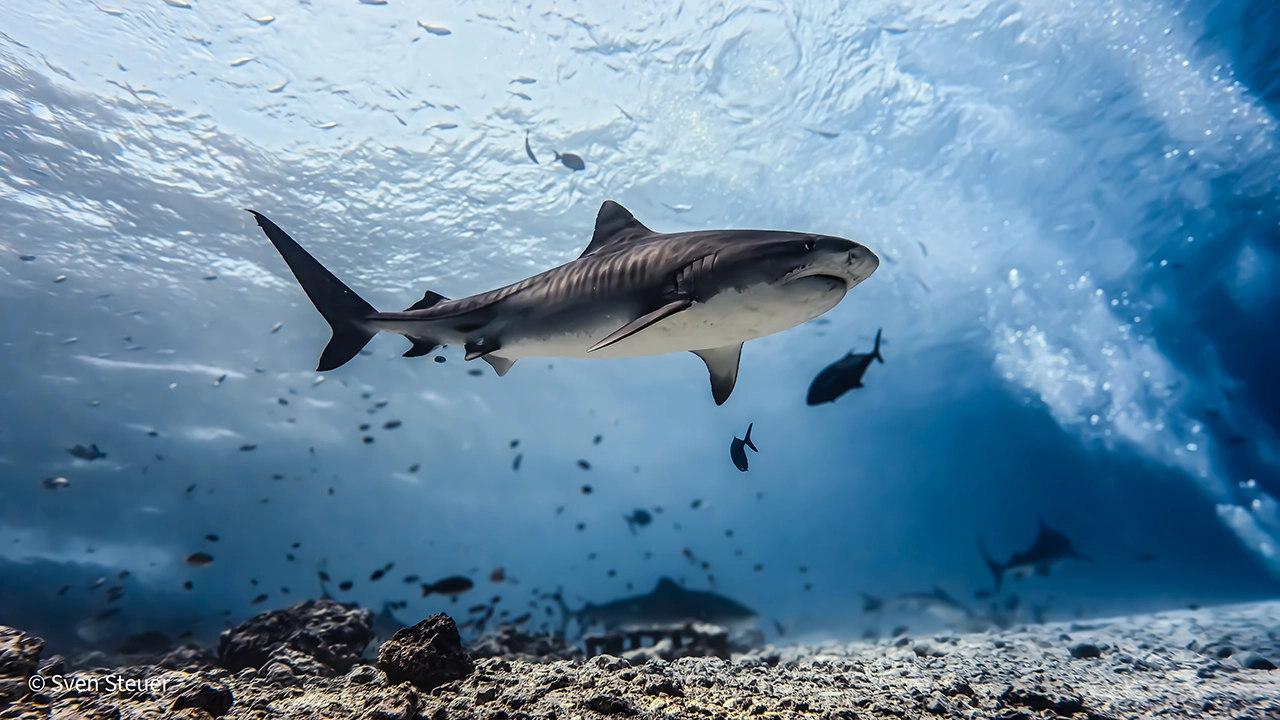
Tiger sharks move between open water and areas close to the coast. This way of life plays an important role in many discussions about incidents.
In this podcast, Sven Steuer of Diver on Tour puts encounters with tiger sharks into context, drawing on many years of diving experience. The focus is on the behaviour of large sharks, body language, personal space, risk factors and how to handle encounters safely underwater.
The podcast complements the expert article and explains why distance, calm behaviour, clear escape routes, group behaviour and a realistic understanding of how large sharks perceive things are crucial.
When people talk about tiger sharks in the Red Sea, a very one-sided picture quickly emerges. On one side are sensational media reports about serious incidents. On the other are pictures of divers who seem completely relaxed in the water with large sharks. Both show only part of the reality. Anyone who wants to understand tiger sharks has to look more closely.
The tiger shark is one of the large predatory sharks of our oceans. Large individuals can grow several metres long, move powerfully and have a very broad diet. Fish, rays, turtles, seabirds, carrion and occasionally unusual prey are all part of its natural behaviour.
It is precisely this adaptability that makes it so successful. The tiger shark is not a specialist focused on one particular prey. It seizes opportunities. It investigates situations. It is curious, strong and able to adapt to very different habitats.
Its reputation as a dangerous shark does not come out of nowhere. Worldwide, the tiger shark is among the species named more often than many other shark species in serious incidents involving humans. However, it must not be concluded from this that tiger sharks deliberately hunt humans. Most encounters between humans and sharks pass without incident.
Yes, tiger sharks do occur in the Red Sea. Even so, encounters are not an everyday event. Many divers spend years in the Red Sea without ever seeing a tiger shark. Individual sightings are possible, especially in deeper, more open or less frequented areas.
The key point is this: a tiger shark is not a small reef shark that calmly passes along the reef edge and disappears again. It is a large predator with its own personal space. An encounter demands attention, calm behaviour and a realistic understanding of possible risks.
Anyone who sees a tiger shark underwater often describes it as calm, almost relaxed. The animal moves slowly, powerfully and in a controlled way. Yet this very behaviour is often misunderstood. Calm does not mean harmless.
A large tiger shark observes its surroundings very closely. It changes its distance, circles, approaches and moves away again. Sometimes this behaviour seems curious. In fact, the animal is assessing the situation: What is in the water? How is it moving? Is it interesting? Is it a nuisance? Is it food? Or does distance need to be established?
Sharks have no hands. They cannot touch or push away unfamiliar things. Part of their exploratory behaviour takes place through approach, body posture and, in the worst case, a bite. That is why it is so important not to crowd large sharks, not to lure them, not to chase them and not to provoke them further with frantic movements.
In recent years there have been several serious incidents in the Egyptian Red Sea that were reported internationally. A careful assessment is important here: not every incident can be clearly attributed to a tiger shark. The media quickly speak of a "shark attack", while the exact species identification is not always reliably documented in public.
A tourist was fatally injured while swimming in the Red Sea. The case became known internationally. In many reports, however, a clear, publicly reliable identification of the species is not sufficiently documented.
In another incident, a boy and a guide suffered serious injuries. This case, too, was widely reported. For an expert assessment, what matters is which species was involved, what exactly the situation looked like and which triggers may have played a role.
Two fatal incidents within a few days drew worldwide attention. In the public discussion, a large coastal shark or tiger shark was named as a possible or probable species.
On June 8, 2023, a Russian swimmer was fatally injured near Hurghada. After the investigation, the Egyptian authorities confirmed a tiger shark as the species involved. This incident shaped public perception particularly strongly.
At the end of December 2024, another fatal incident occurred near Marsa Alam, in which a second swimmer was injured. Here too, any attribution to a species should be treated with caution unless it has been clearly and reliably documented.
There is no simple answer. Serious shark incidents rarely have a single cause. Usually several factors come together: environmental conditions, human behavior, visibility, food availability, proximity to fishing activity or waste, and sometimes the behavior of one individual animal that stands out.
With tiger sharks in particular, a range of triggers are discussed worldwide. These include exploratory behavior, competition for food, fish waste, illegal feeding, injured prey, murky water, dusk, swimming outside designated areas, and proximity to places where organic waste regularly ends up in the water.
One particularly critical point is habituation to food. Sharks learn quickly. If certain places are regularly associated with food, fish scraps or organic waste, the behavior of individual animals can change.
This is exactly why illegal feeding, improper disposal of fish waste and uncontrolled proximity to fishing activities are problematic. They can draw sharks into areas where swimmers, snorkelers or divers are in the water at the same time.
After a serious incident, people often talk in sweeping terms about “the sharks”. From a scientific point of view, that is wrong. The vast majority of sharks show no unusual behavior toward humans.
Individual animals can, however, react differently. Food, injury, stress, reproduction, illness or habituation to certain stimuli can change behavior. That is why very precise questions need to be asked after an incident: Which species was involved? Where did it happen? Was there fish waste? Was there feeding? Were there special environmental conditions? Had the same animal already been seen behaving unusually several times before?
Worldwide, shark incidents remain rare despite the heavy media attention. At the same time, millions of people go swimming, snorkeling, surfing or diving every year.
But that doesn't mean large sharks are harmless. Rare does not mean impossible. The right perspective lies between panic and downplaying the risk. Large sharks are wild animals. They need space, clear escape routes and human behavior that avoids unnecessary risks.
For divers, the situation is often very different from swimming at the surface. Divers move in a more controlled way, stay in groups, wear equipment and are often accompanied by experienced guides. Even so, clear basic rules apply when encountering large sharks.
Tiger sharks in the Red Sea are fascinating, large predatory sharks. They are neither harmless attractions nor monsters. They are wild animals with complex behavior, a large range and an important role in the marine ecosystem.
The serious incidents of recent years must be taken seriously. At the same time, they shouldn't lead to blanket fear. Anyone who wants to understand the causes has to look more closely: at human behavior, fishing, waste, feeding, environmental conditions and the possibility of individual animals that stand out.
Only a factual assessment helps to reduce risks. Not by downplaying them. Not through panic. But through knowledge, experience and a realistic understanding that we are moving through the habitat of a large predator.
This training video is about behavior, body language, risk factors and the respectful handling of tiger sharks.


