Why Blaming Reef Decline Only on Rising Water Temperatures Falls Short
Hardly any topic in environmental debates is portrayed as simplistically as the worldwide decline of coral reefs. The public explanation often follows the same pattern: the oceans are getting warmer, and therefore the corals are dying. This explanation is catchy, but from a scientific perspective it falls clearly short.
Coral Reefs Rarely Die from a Single Cause
Coral reefs respond to a complex interplay of water quality, pollutant load, sediments, nutrient input, shipping traffic, coastal development, industrial discharge and biological stability. The Red Sea in particular shows how problematic it is to reduce a highly complex environmental problem to a single factor.
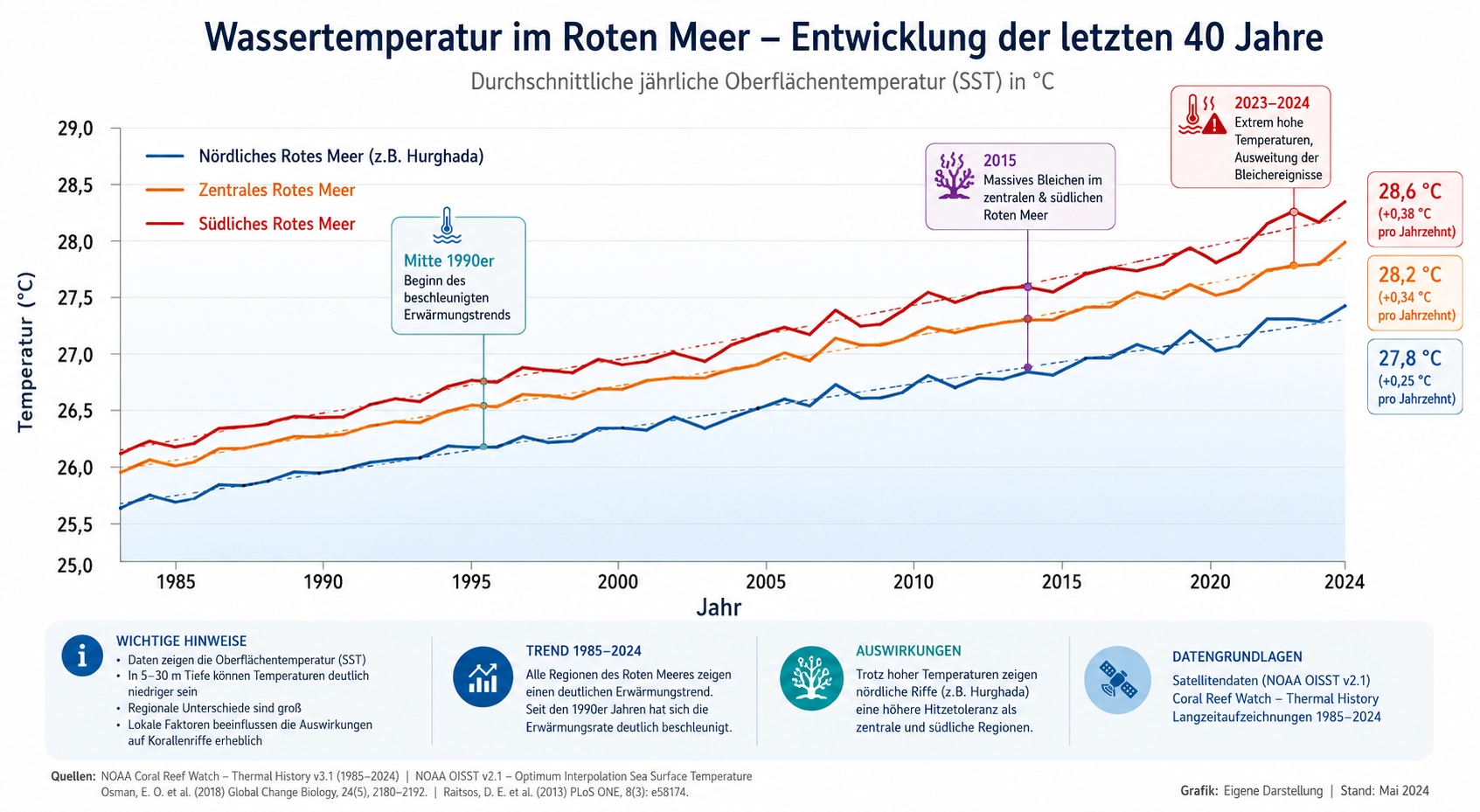
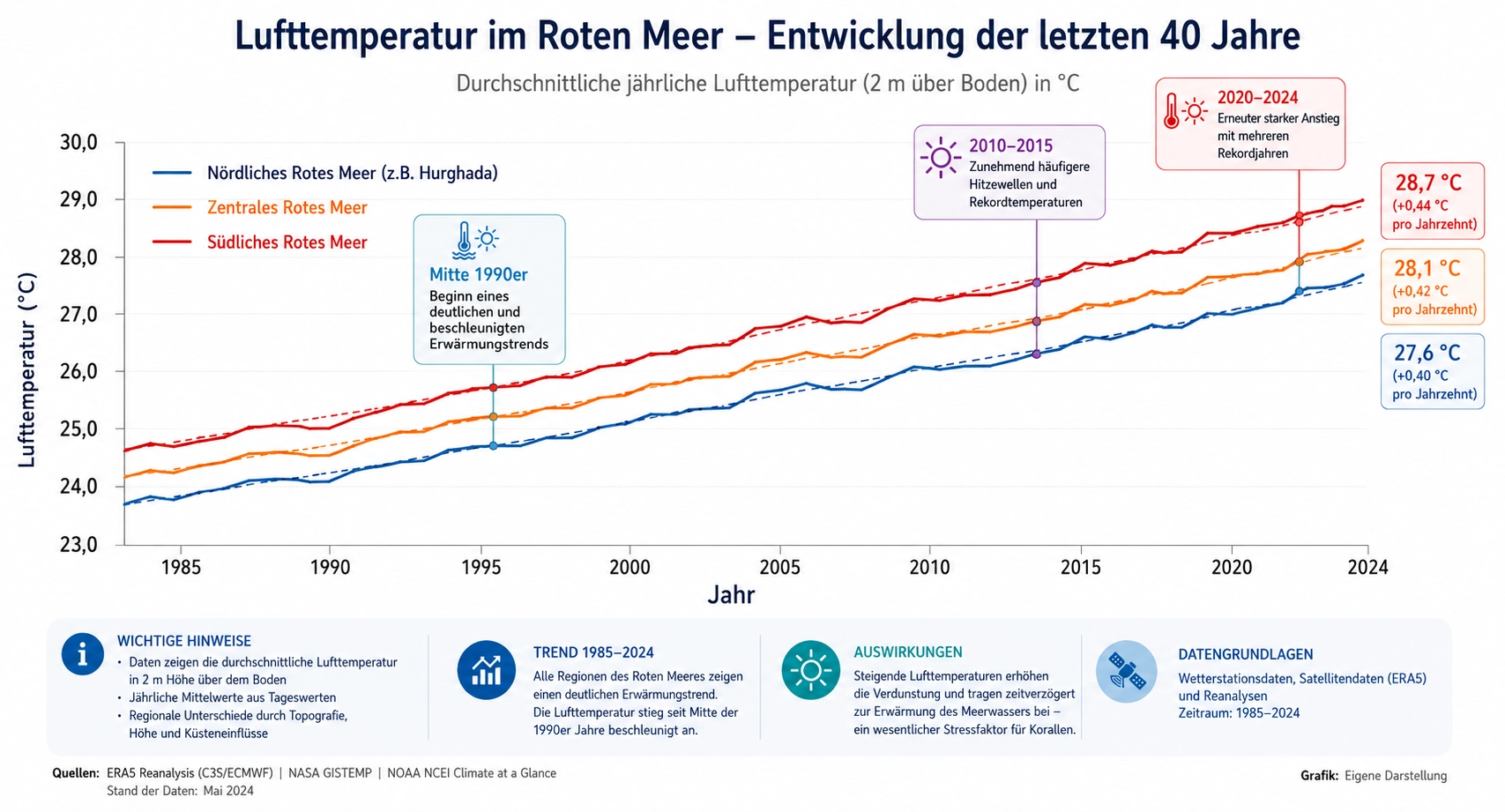
Ocean warming is real. Long-term measurements by NOAA, NASA and various research institutes show a clear rise in sea surface temperatures since the 1980s. Rising temperatures have also been documented in the Red Sea. But this is exactly where the actual scientific discussion begins.
Temperature Trends in the Red Sea
Many public statements are based almost exclusively on so-called SST data, i.e. measurements of sea surface temperature. This data is important, but it does not automatically reflect the actual conditions at the depths where many corals live.
Temperature at Different Depths
Corals often live at depths between five and thirty meters. Temperature conditions there can differ from those right at the surface. More recent studies show that warming can weaken significantly with increasing depth.
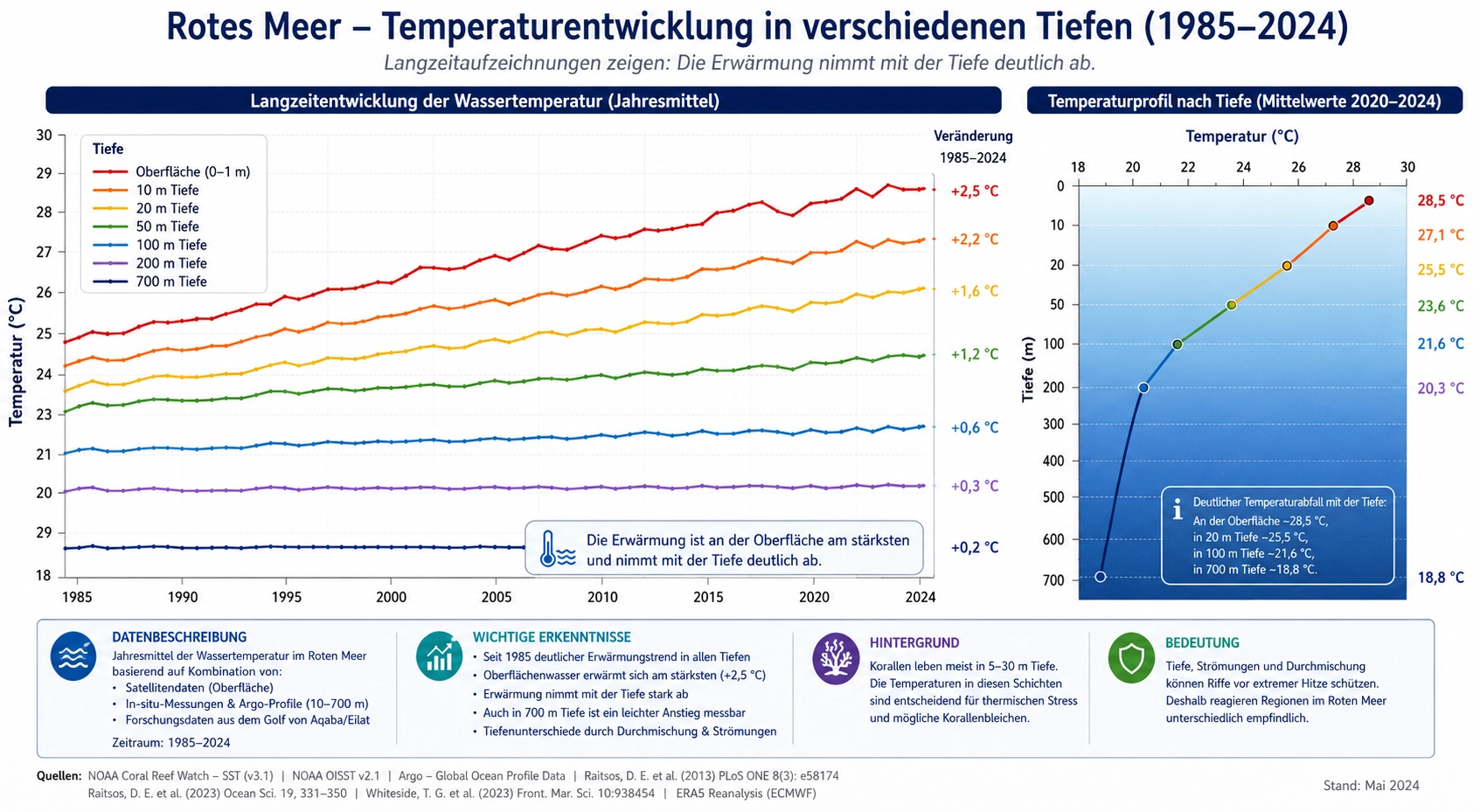
At the same time, the effects vary considerably by region. While some nearshore reefs show massive damage, numerous offshore reefs and northern areas of the Red Sea still appear remarkably stable. Several studies even describe parts of the northern Red Sea as a thermal refuge with exceptionally heat-tolerant coral populations.
Why Temperature Alone Doesn't Fully Explain the Picture
If temperature alone were the decisive cause of worldwide reef decline, the damage would have to be distributed far more evenly. Yet that is exactly what we do not observe. Heavily polluted coastal regions often show the greatest damage.
This suggests that temperature stress often does not act in isolation but amplifies existing stressors. A reef that is already weakened by poor water quality, sediments, pollutants or nutrient input reacts more sensitively to additional heat periods.
Industry, Oil, Shipping and Coastal Development
The Red Sea has changed massively since the 1980s. The Gulf of Suez in particular developed into an important oil and industrial corridor of the region. Offshore platforms were expanded, production fields enlarged, tanker routes intensified and industrial ports enlarged.
Environmental pressures rose along with this development. Satellite analyses regularly document oil spills in the Gulf of Suez. Studies point to hydrocarbons, heavy metals and industrial residues. Added to this are sediment inputs from coastal construction, nutrient loads from wastewater, microplastics and chemical discharges from industry and shipping.
Corals react sensitively to such stressors. Oily substances, pollutants and increased nutrient inputs can impair growth, reproduction and resilience. As a result, polluted coastal reefs can collapse much faster than offshore systems with better water flow.
Coastal Reefs and Offshore Reefs React Differently
The dynamics of the Red Sea play an important role here. Currents, water exchange, oxygen levels, sediment transport and local inputs influence how heavily a reef is stressed. In many places, offshore reefs benefit from better water flow and lower local pollutant concentrations.
Nearshore regions, by contrast, more often accumulate precisely those stressors that are barely addressed in simplified climate debates: wastewater, sediments, port construction, industrial discharge, waste and increased use by shipping or tourism.
Conclusion
Global warming is real, and temperature stress plays an important role for coral reefs. Reducing reef decline to rising water temperatures alone, however, does not do justice to the actual complexity of marine ecosystems.
The Red Sea in particular shows that coral reefs do not respond to a single factor but to the sum of all stressors. Anyone who seriously wants to understand reef decline must look not only at temperature curves but also at water quality, pollutants, coastal development, shipping, the oil industry and local environmental pressures.
Sources
- Fine, M. et al. (2013): A coral reef refuge in the Red Sea. Global Change Biology.
- Osman, E. O. et al. (2018): Thermal refugia against coral bleaching throughout the northern Red Sea. Global Change Biology.
- Raitsos, D. E. et al. (2011): Abrupt warming of the Red Sea. Geophysical Research Letters.
- El-Magd, I. A. et al. (2023): Oil pollution monitoring in the Gulf of Suez using SAR satellite data. Egyptian Journal of Remote Sensing and Space Sciences.
- NOAA Coral Reef Watch – Long-term SST datasets.
- PERSGA Environmental Reports – Red Sea and Gulf of Aden regional assessments.
- UNEP Regional Seas Reports – Marine Pollution in the Red Sea Region.


